
A temporary restraining order (TRO) in Texas is a civil emergency court order that stops a party from taking harmful actions until a judge can hold a full hearing, generally within a short time frame often about two weeks. If you are facing an immediate threat to your children, your property, or your safety during a divorce or custody case, your two most urgent steps are: file a Motion for Temporary Restraining Order with a sworn affidavit, or call a family-law attorney who can file it for you today.
Before you file, have these three things ready:
- Your petition or existing case number (or be prepared to file the original petition simultaneously)
- A sworn affidavit describing specific facts showing immediate and irreparable harm
- Supporting evidence: text messages, photos, police reports, or witness statements that document the threat
Key Takeaways
A TRO in Texas is a civil emergency order that lasts up to 14 days, requires a sworn affidavit showing immediate harm, and is enforced through civil contempt, not criminal arrest.
| Point | Details |
|---|---|
| TRO duration | A Texas TRO lasts up to 14 days or until the temporary-orders hearing, whichever comes first. |
| Affidavit is critical | The sworn affidavit must state specific facts and recent incidents, not general concerns, to satisfy the court. |
| Civil vs. criminal enforcement | TRO violations are handled through civil contempt; protective-order violations can result in criminal arrest. |
| County standing orders | Check your county’s local rules before filing; some counties already impose automatic restrictions on filing. |
| Lawofficeofannadin | The firm handles emergency TRO filings, temporary-orders hearings, and enforcement in The Woodlands, Houston, and surrounding areas. |
Table of Contents
- What is a temporary restraining order in Texas, and how does it differ from other orders?
- When is a TRO appropriate in divorce, custody, and other family-law cases?
- How do you request a TRO in a Texas family-law case?
- What can a TRO actually include, and what is off-limits?
- What happens at the temporary-orders hearing, and how does notice work?
- How are TRO violations handled, and what are the consequences?
- How long does a TRO last, and what does it cost to file?
- Where do you find official Texas TRO forms and resources?
- How can a family-law attorney help with your TRO?
- Common mistakes to avoid when filing a TRO in Texas
- What Texas family courts actually expect from TRO filings
- Lawofficeofannadin can help you file and enforce a TRO
- Sources
- FAQ
What is a temporary restraining order in Texas, and how does it differ from other orders?
A TRO in Texas is a short-term civil order issued by a family court to preserve the status quo while a case is pending. Texas Family Code §6.501 specifically authorizes courts to grant a TRO after a suit for dissolution of marriage is filed, and it lists explicit limits on what that order may include. The procedural framework comes from Texas Rules of Civil Procedure Rules 680–693a, which govern timing, notice requirements, and the standards for ex parte relief.
Understanding the difference between a TRO and other protective orders matters because the enforcement path is completely different.
According to the Texas State Law Library, TROs are civil emergency orders tied to a pending lawsuit, while protective orders are safety orders for victims of family violence that can carry criminal penalties for violations and may last up to one year or longer. That distinction is not academic. If someone violates a TRO, you pursue civil contempt. If someone violates a final protective order, law enforcement can arrest them on the spot.
County standing orders add another layer. Many Texas counties, including Travis County, issue automatic standing orders the moment a family case is filed. These orders immediately restrict both parties from harassing each other, removing children from the state, or dissipating marital assets. Check your county’s local rules before drafting your TRO request, because a judge may decline to sign redundant language already covered by a standing order.
When is a TRO appropriate in divorce, custody, and other family-law cases?
A TRO fits situations where waiting for a scheduled hearing would allow real harm to occur. Courts look for urgency and specificity, not general unhappiness with the other party’s behavior.
Common scenarios where Texas courts grant TROs in family cases include:
- Imminent removal of children from Texas or to an unknown location, especially when one parent has threatened to relocate without consent
- Threatened destruction or dissipation of marital property, such as emptying joint bank accounts, selling community assets, or destroying personal property
- Harassment, stalking, or threatening conduct tied to the divorce or custody proceeding
- Interference with a child’s school enrollment, medical care, or daily routine in a way that causes immediate harm
- Threats to cancel health insurance or other financial accounts that the family depends on
TROs do have real limits, and courts enforce those limits strictly. The Travis County Law Library notes that a TRO can order a party not to harass, harm property, or remove children, but it cannot always accomplish remedies like ejecting a spouse from the home or ordering permanent custody. Specifically, a TRO generally cannot:
- Make long-term or final custody determinations
- Order a final division of community property
- Force the sale of the marital home
- Bar a spouse from reasonable living expenses from joint accounts
- Substitute for a protective order when family violence is the primary concern
When your concern is primarily child safety during a divorce, understanding what Texas courts consider in custody decisions helps you frame your affidavit around the factors a judge will actually weigh.
Emergency custody vs. TRO: An emergency custody order (sometimes called a temporary conservatorship order) is a related but distinct tool. It specifically addresses who has the right to possession of a child on an emergency basis. A TRO in a divorce case may include limited child-possession language, but a standalone emergency custody order under Texas Family Code §156.006 applies in modification cases where a child faces immediate danger. If your situation involves a child in danger outside of an active divorce filing, discuss the right vehicle with a family-law attorney before you file.
How do you request a TRO in a Texas family-law case?
The filing process is sequential and time-sensitive. Each step builds on the last, and a gap in any one of them can delay or sink the request.
-
File the original petition (or confirm your case is already open). A TRO in a divorce case requires an active suit. If you have not yet filed for divorce, you file the Original Petition for Divorce and the Motion for Temporary Restraining Order simultaneously. Reviewing a practical pre-filing checklist before you go to the courthouse saves significant time.
-
Prepare the Motion for Temporary Restraining Order. The motion identifies the specific relief you are requesting and the legal basis for it. Be precise: vague requests give a judge no enforceable standard to apply.
-
Attach a sworn affidavit. This is the most critical document. The affidavit must be signed under penalty of perjury and must describe specific facts, not conclusions, showing that immediate and irreparable harm will occur if the court does not act before a hearing. According to TexasLawHelp, a petitioner must file this affidavit to explain the immediate necessity for relief.
-
Include a proposed TRO order. Draft the exact language you want the judge to sign. Courts often sign proposed orders with minimal changes when the language is clear and legally appropriate.
-
Attach the Order to Appear and Proposed Support Decision forms. These schedule the temporary-orders hearing and set the framework for support and possession decisions at that hearing. The TexasLawHelp TRO packet for divorce with children includes all of these forms, along with step-by-step instructions for completing them.
-
Request ex parte review if the harm is immediate. An ex parte TRO is issued without prior notice to the other party. The judge reviews your motion and affidavit alone. If the facts support immediate danger, the judge may sign the TRO on the spot.
-
Serve the respondent. Once the TRO is signed, the other party must be formally served with the TRO, the petition, and the notice of the temporary-orders hearing. The county clerk’s office can direct you to the proper service method.
Evidence that strengthens an affidavit:
- Screenshots of threatening text messages or emails (with dates and timestamps)
- Photos of property damage or injuries
- Police reports or incident numbers
- School or medical records showing interference with the child’s care
- Witness statements from neighbors, family members, or teachers
Practical timeline:
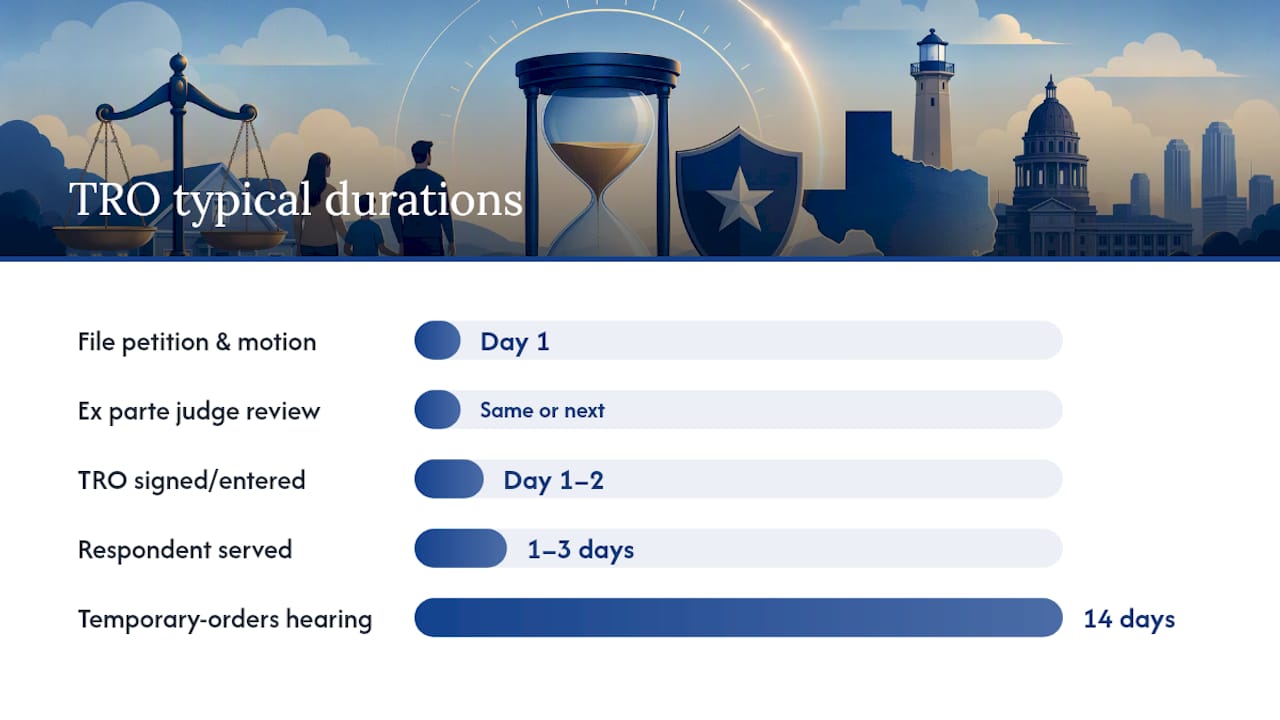
Filing → Ex parte review by judge (same day or next day) → TRO signed → Respondent served → Temporary-orders hearing (within 14 days of TRO entry)
What can a TRO actually include, and what is off-limits?
Judges in Texas family cases routinely include the following types of relief in a TRO:
- No-contact or limited-contact provisions (no calls, texts, or in-person contact except through counsel)
- Stay-away orders from the family home, the child’s school, or the other party’s workplace
- Orders to preserve marital property and prohibit the transfer, sale, or destruction of community assets
- Restrictions on canceling health, auto, or life insurance policies
- Temporary restrictions on removing children from a specific geographic area or from Texas
- In extreme emergencies, limited child-possession language pending the temporary-orders hearing
What a TRO cannot include is equally important. Under Texas Family Code §6.501, the statute lists specific prohibitions on TRO relief in divorce cases. Courts will not sign a TRO that:
- Establishes final or long-term conservatorship (custody)
- Orders a final division of community property
- Bars a party from withdrawing reasonable amounts from community accounts for living expenses
- Ejects a spouse from the marital home in most circumstances (this typically requires a separate motion and hearing)
- Orders permanent child support amounts
Pro Tip: Write your requested relief in plain, specific language a sheriff’s deputy could enforce without calling a lawyer. Instead of “Respondent shall not interfere with children,” write “Respondent shall not remove the minor children, [names], from Montgomery County, Texas, without prior written consent of Petitioner or court order.” Specificity is what makes a TRO enforceable.
What happens at the temporary-orders hearing, and how does notice work?
The temporary-orders hearing is the proceeding where the emergency TRO transitions into binding temporary orders that govern the case until trial or settlement. Unlike the ex parte TRO review, this hearing requires notice to both parties, and both sides present evidence.
What to bring to the hearing:
- Copies of all filed documents (petition, TRO, affidavit, any responses filed by the other party)
- Financial records: pay stubs, bank statements, tax returns, and a monthly expense summary
- A proposed Temporary Orders document with your requested terms for custody, support, and property
- Any additional evidence gathered since the TRO was signed (new messages, incident reports)
- Your witness list, with witnesses available to testify or provide sworn statements
How the hearing works in practice:
Many Texas family courts limit each side to 30–60 minutes of presentation time, though this varies by county and judge. Some courts in the Houston area and The Woodlands follow local administrative rules that set specific time limits for temporary-orders hearings. Check your county’s local rules on the court’s website or through the county clerk before the hearing date.
The judge will consider temporary conservatorship (custody), a temporary possession schedule, temporary child support, temporary spousal support if applicable, and who has the right to use the marital home during the case. The outcome of this hearing often shapes the entire trajectory of the divorce, which is why preparation matters as much here as at trial.
If you cannot attend the hearing, notify your attorney immediately. Missing a temporary-orders hearing without a continuance can result in orders entered entirely on the other party’s terms.
How are TRO violations handled, and what are the consequences?
Violating a TRO is a serious matter, but the enforcement path differs from violating a protective order.
Civil contempt for TRO violations:
When a party violates a TRO, the remedy is a motion for contempt of court filed in the same family case. The moving party must show the court that: (1) a valid TRO existed, (2) the respondent had notice of it, and (3) the respondent willfully violated its terms. If the judge finds contempt, available remedies include fines, attorney’s fees, and in some cases, confinement. Civil contempt does not result in a criminal record.
Criminal enforcement for protective-order violations:
This is the critical distinction. As the Texas State Law Library explains, violating a protective order can result in criminal arrest, while TRO violations follow the civil contempt path. If your safety concern rises to the level of family violence, a protective order may give you stronger, faster enforcement tools than a TRO.
For more detail on what happens when someone crosses the line on a protective order, the firm’s resource on protective order violations in Texas walks through the criminal consequences and your options.
After a violation occurs:
- Document everything immediately: save messages, take photos, note the date and time
- File a police report if any physical threat or contact occurred
- Contact your attorney to file a motion for enforcement or contempt
- Ask the court for emergency relief if the violation puts children or property at immediate risk
How long does a TRO last, and what does it cost to file?
TRO duration and timeline:
A TRO in Texas typically lasts 14 days from the date it is signed, or until the temporary-orders hearing, whichever comes first. TexasLawHelp confirms that TROs are emergency orders that generally last 14 days or until the temporary-orders hearing. A judge may extend a TRO for good cause, but extensions are not automatic and require a showing that the extension is necessary.
| Stage | Typical Timing |
|---|---|
| File petition and TRO motion | Day 1 |
| Ex parte judge review | Same day or next business day |
| TRO signed and entered | Day 1–2 |
| Respondent served | Within 1–3 days of signing |
| Temporary-orders hearing | Within 14 days of TRO entry |
| Temporary orders entered | At or shortly after hearing |
| Case proceeds to trial or settlement | Weeks to months later |
Costs:
Filing fees for a divorce petition in Texas vary by county. In Harris County, for example, the filing fee for an original divorce petition is set by the county clerk and is publicly listed on the clerk’s fee schedule. Montgomery County and other surrounding counties have their own fee schedules, which you can verify directly with the county clerk’s office or on the court’s website.
Protective order filings in Texas are generally free of charge for the petitioner when family violence is alleged. A TRO filed as part of a divorce case, however, is subject to the standard civil filing fees for that county.
Tracking deadlines:
Once your TRO is signed, note the hearing date on the face of the order. Contact the county clerk if you need to confirm the docket time or request a continuance. Missing the 14-day window without an extension can cause the TRO to lapse.
Where do you find official Texas TRO forms and resources?
These are the primary sources for forms, statutes, and county-specific guidance:
- TexasLawHelp TRO packet: The most complete self-help resource for divorce-with-children TRO filings. The packet includes the Motion for TRO, Affidavit in Support, TRO Order to Appear, Proposed Support Decision, and Standard Possession Order templates, along with step-by-step instructions.
- TexasLawHelp article on TROs and temporary orders: Plain-language explanation of the TRO process, affidavit requirements, and what to expect at the temporary-orders hearing.
- Texas Family Code §6.501 via FindLaw: The statute itself, showing exactly what a court may and may not include in a TRO after a divorce suit is filed.
- Texas State Law Library protective orders guide: Explains the full spectrum of protective orders and TROs, including enforcement differences and procedural rules.
- Travis County Law Library pamphlet: Covers TROs, protective orders, and peace bonds with county-specific context, including standing orders.
- County clerk websites: Each Texas county posts its local rules, standing orders, and fee schedules. Search “[your county] district clerk family law standing orders” to find the applicable rules for your courthouse.
- statutes.capitol.texas.gov: The official Texas Legislature site for reading the full text of the Family Code and Rules of Civil Procedure.
- Womenslaw: Plain-language legal information for survivors of domestic violence navigating protective orders and TROs in Texas.
How can a family-law attorney help with your TRO?
Filing a TRO without counsel is possible using the TexasLawHelp forms, but the stakes are high enough that attorney involvement makes a measurable difference in outcomes. TexasLawHelp itself advises consulting a qualified family-law attorney before seeking temporary orders, because missteps in the initial filing or hearing can have long-term consequences for custody, property, and safety.
Here is what an attorney handles that forms cannot:
- Drafting a targeted affidavit that focuses on the specific facts most likely to persuade a judge to sign an ex parte TRO, rather than a generic recitation of concerns
- Presenting the ex parte request to the judge in person, answering questions, and correcting deficiencies on the spot
- Navigating courthouse procedure in your specific county, including local rules, standing orders, and judge preferences that are not published anywhere
- Preparing for the temporary-orders hearing with a witness plan, financial exhibits, and a proposed order the judge can sign
- Filing enforcement motions if the other party violates the TRO before the hearing
Situations where hiring counsel is strongly recommended:
- The other parent has threatened to take children out of state or out of the country
- There is a history of domestic violence, threats, or weapons in the home
- The marital estate includes business interests, retirement accounts, or real property that could be dissipated quickly
- The other party already has an attorney
- A prior TRO or protective order has been violated
Pro Tip: Bring a written timeline of events to your first attorney consultation, not just a verbal summary. A one-page chronology with dates, locations, and what was said or done gives your attorney the raw material to build a compelling affidavit immediately, rather than spending consultation time reconstructing facts.
Lawofficeofannadin serves clients in The Woodlands, Houston, and surrounding communities. The firm’s child custody practice and TRO representation are built around the specific procedural realities of Montgomery County and Harris County courts.
Common mistakes to avoid when filing a TRO in Texas
Even well-intentioned filers make errors that delay or defeat a TRO request. These are the most common ones, and how to avoid them.
- Vague affidavits. Statements like “I am afraid for my children’s safety” do not satisfy the legal standard. Name specific incidents, dates, and what was said or done. Courts need facts, not conclusions.
- Failing to show immediacy. If the incident you describe happened three weeks ago and nothing has happened since, a judge may find the harm is not imminent. Describe the most recent threat or action and explain why the risk is ongoing.
- Requesting relief a TRO cannot grant. Asking for final custody, ejection from the home without a separate motion, or permanent division of property will cause a judge to reject or narrow your order. Know the limits before you draft the request.
- Missing or incorrect service. A TRO that is not properly served on the respondent cannot be enforced. Follow the county clerk’s instructions for service exactly.
- Ignoring standing orders. Some counties already restrict the conduct you are trying to restrain. Filing a TRO that duplicates a standing order wastes court time and can signal to the judge that you are unfamiliar with local rules.
- Failing to prepare for the temporary-orders hearing. The TRO is only the first step. If you arrive at the hearing without financial records, a proposed order, or a witness plan, the other party’s attorney will control the outcome.
Pro Tip: Before you file, pull your county’s local family-law standing orders from the county clerk’s website or the court’s local rules page. Highlight what is already covered. Then draft your TRO to address only the gaps. A focused, non-redundant request reads as credible and well-prepared to a judge.
For guidance on how to modify a restraining order after it has been entered, this resource on restraining-order modifications covers the process and what courts require.
What Texas family courts actually expect from TRO filings
Courts in Texas family cases see a high volume of TRO requests, and judges develop a clear sense of which filings reflect genuine emergencies and which reflect litigation strategy. The difference almost always comes down to specificity. A well-drafted affidavit that names dates, quotes specific statements, and attaches documentary evidence gets taken seriously. A generic affidavit that describes a pattern of bad behavior without anchoring it to recent, verifiable facts often does not.
The temporary-orders hearing is where the real work happens. The TRO buys you time. What you do with that time, gathering evidence, preparing witnesses, and drafting enforceable proposed orders, determines whether the temporary orders that follow actually protect you and your children. Clients who arrive at the hearing prepared consistently achieve better outcomes than those who treat the TRO as the finish line rather than the starting point.
Lawofficeofannadin can help you file and enforce a TRO
When a family crisis requires immediate court action, having the right attorney file your TRO correctly the first time protects your children and your rights from day one. Lawofficeofannadin serves families in The Woodlands, Houston, Fairfield, Hockley, and surrounding Texas communities, handling TRO filings, temporary-orders hearings, and enforcement actions with the local court knowledge that makes a real difference.

The firm’s restraining and protective orders practice covers the full range of emergency family-law relief, including:
- Emergency TRO filings and ex parte presentations
- Temporary-orders hearing preparation and representation
- Enforcement and contempt actions when orders are violated
- Emergency custody representation for parents facing child-removal threats
- Divorce representation where TROs and temporary orders are part of the case
If you are ready to take the next step, contact the Law Office of Anna Din directly through the firm’s contact page or visit the divorce attorney practice page to learn more about representation during divorce proceedings where TROs are involved.
Sources
- Types of Protective Orders – Texas State Law Library
- Texas Family Code – FAM § 6.501 | FindLaw
- Temporary Orders and Temporary Restraining Orders (TROs) | Texas Law Help
- Protective Order? Restraining Order? Peace Bond? – Travis County Law Library pamphlet
To read the statute directly, go to statutes.capitol.texas.gov, select “Family Code,” and navigate to Title 1, Chapter 6, Section 6.501. County standing orders are typically found on the district clerk’s website under “Local Rules” or “Family Law Standing Orders.”
This article is general information, not a substitute for advice from a qualified lawyer. Consult a qualified legal professional about your own circumstances before acting on anything here.
FAQ
How does a temporary restraining order work in Texas?
A TRO is a civil court order that prohibits a party from taking specific actions, such as removing children from the state or dissipating marital assets, until a temporary-orders hearing can be held. The petitioner files a motion and sworn affidavit, and a judge may sign the order ex parte (without the other party present) if immediate harm is shown.
How long does a temporary restraining order last in Texas?
A TRO in Texas typically lasts 14 days or until the temporary-orders hearing, whichever comes first. A judge may extend the TRO for good cause, but the extension is not automatic.
How much does it cost to file a TRO in Texas?
Filing fees vary by county and are set by each county clerk’s office. Protective order filings are generally free when family violence is alleged, but a TRO filed as part of a divorce case is subject to standard civil filing fees for that county.
How do you get a temporary order in Texas?
File a Motion for Temporary Restraining Order alongside your original petition (or as a separate motion in an active case), attach a sworn affidavit describing specific facts showing immediate harm, include a proposed TRO order, and submit the Order to Appear to schedule the temporary-orders hearing. The TexasLawHelp TRO packet provides all required forms for divorce-with-children cases.
What is the difference between a TRO and a protective order in Texas?
A TRO is a civil order tied to a pending lawsuit and enforced through civil contempt, while a protective order is a safety order for family-violence victims that carries criminal penalties for violations and can last up to two years or longer, as explained by the Texas State Law Library.