
A Rule 11 agreement in Texas is a written or on-the-record contract between parties or their attorneys that a court will enforce once it meets the formal requirements of Tex. R. Civ. P. 11. The rule is straightforward: the agreement must be in writing, signed, and filed with the court papers, or it must be made in open court and entered of record. If neither condition is met, the agreement is unenforceable, no matter how clearly both sides understood the deal.
The single most important action you can take after reaching any agreement is to get it into the record immediately. If the terms affect children or money, go one step further: ask the judge to incorporate the agreement into a signed order or final judgment. That step transforms a private contract into a court order with contempt and enforcement power behind it.
Table of Contents
- What does Tex. R. Civ. P. 11 actually require?
- How do you form a valid Rule 11 agreement in Texas?
- When should you use a Rule 11 agreement?
- Can a Rule 11 agreement decide custody or visitation?
- Using Rule 11 agreements for procedural and discovery matters
- How do you enforce a Rule 11 agreement in Texas?
- What happens when someone breaks a Rule 11 agreement?
- Do you need a lawyer for a Rule 11 agreement?
- Practical drafting tips and red flags to avoid
- How a Texas family lawyer uses Rule 11 agreements in practice
- Key Takeaways
- The weight of getting it right
- How the Law Office of Anna Din helps with Rule 11 agreements
- Useful sources to read next
- FAQ
What does Tex. R. Civ. P. 11 actually require?
Rule 11, as amended through August 27, 2024, governs every agreement between attorneys or parties that touches a pending lawsuit in Texas. Its requirements are brief but strict.
“No agreement between attorneys or parties touching any suit pending will be enforced unless it be in writing, signed and filed with the papers as part of the record, or unless it be made in open court and entered of record.” — Tex. R. Civ. P. 11
The rule serves a clear purpose: it prevents disputes about what was or was not agreed to during litigation. Before Rule 11, oral side deals between counsel were common, and courts spent significant time sorting out conflicting recollections. The writing requirement cuts that problem off at the source.
Key legal points to understand:
- Open-court alternative: — If both sides state the agreement on the record in open court and the judge enters it, no separate written document is required.
How do you form a valid Rule 11 agreement in Texas?
Formation is where many agreements fall apart. Follow this checklist to protect your position from the start.
Who must sign and what counts as a signature:
- The party themselves or their licensed attorney of record may sign.
- Electronic signatures are generally accepted, but the intent must be clear.
- Emails can qualify as a written Rule 11 agreement only when the email explicitly states it is intended to serve as one. TexasLawHelp is direct on this point: a casual email confirmation or a standard email signature block alone will not meet the requirement. Add a sentence such as: “This email constitutes a Rule 11 Agreement under Tex. R. Civ. P. 11.”
Filing the written agreement:
- File the signed agreement with the district or county clerk as part of the case record.
- Mark the document clearly: “Rule 11 Agreement” in the caption, with the cause number and court.
- Request a file-stamped copy for your records.
- Attach a proposed agreed order if you want the judge to sign off immediately.
The open-court option:
- Both parties or their attorneys state the agreement on the record before the judge.
- The judge enters the agreement in the record (the court reporter transcribes it).
- Ask the judge to sign an agreed order reflecting the terms before leaving the courtroom.
Practical steps after filing:
- Prepare a proposed agreed order or agreed judgment with decretal language.
- Submit it to the judge for signature.
- Once signed, the agreement operates as a court order, not just a contract.
| Method | Pros | Cons |
|---|---|---|
| Written agreement filed with clerk | Creates a paper trail; easy to attach to motions | Requires both signatures; judge has not yet approved |
| Open court / on the record | Immediate record; judge can sign order same day | Requires a court setting; court reporter must be present |
| Email with explicit Rule 11 language | Convenient for remote negotiations | Easily challenged if intent language is missing |
When should you use a Rule 11 agreement?
Rule 11 agreements cover a wide range of situations in both civil and family cases. Knowing when to reach for one saves time and prevents disputes later.
Procedural and scheduling uses are the most common. Attorneys routinely use Rule 11 to extend discovery deadlines, move expert designation dates, or agree to a continuance without filing a formal motion. A quick signed agreement filed with the clerk accomplishes the same result as a court order for most scheduling matters, and it keeps the docket clear.
Settlement uses are equally common. Parties often reach a partial settlement on some issues while others remain contested. A Rule 11 agreement locks in the resolved issues so neither side can walk them back while the remaining disputes are litigated. Full settlement agreements under Rule 11 can resolve the entire case, though you will still need a final judgment or dismissal to close the file.
Family-law uses deserve special attention. In divorce and custody cases, parties use Rule 11 agreements to preserve temporary arrangements, lock in a custody schedule while the case is pending, agree on interim child support, or document property division terms reached at mediation before a formal decree is drafted. For example, spouses who agree on who stays in the family home during a Texas divorce proceeding often memorialize that arrangement in a Rule 11 agreement to prevent either party from changing course before the final decree is signed.

Can a Rule 11 agreement decide custody or visitation?
Parties can agree on custody and visitation terms through a Rule 11 agreement, but the agreement alone does not bind the court. Texas family courts operate under a statutory duty to make custody decisions based on the best interest of the child, and no private contract can override that obligation.
The practical difference between a private Rule 11 agreement and a judge-incorporated order is significant:
- A private Rule 11 agreement on custody is enforceable as a contract, but a parent who violates it cannot be held in contempt unless the terms are incorporated into a court order.
- Once a judge signs an order adopting the parties’ custody terms, violation becomes a contempt matter with real consequences: fines, enforcement hearings, and potentially jail time.
- Courts generally will honor agreed custody arrangements when they reflect the children’s best interest, but the judge retains authority to modify or reject any term that conflicts with that standard.
To make custody terms durable, include language in your Rule 11 agreement that expressly requests judicial incorporation: “The parties request that the Court adopt and incorporate these terms into a final order or decree.” Then follow up with a proposed agreed order for the judge’s signature. Understanding what Texas courts consider when deciding child custody helps you draft terms a judge is likely to approve.
Red flags to avoid in custody agreements:
- Language that attempts to waive a parent’s right to seek future modification (courts will not honor this).
- Provisions that restrict a child’s access to medical care or education without court approval.
- Terms that conflict with an existing protective order. If safety is a concern, a protective order provides stronger enforcement than any private agreement.
- Vague visitation schedules that leave room for dispute (“reasonable visitation” without defined times).
Pro Tip: Ask the judge to sign an agreed temporary order on the day you file your Rule 11 custody agreement. That converts the private contract into a court order immediately, giving you contempt remedies from day one.
Using Rule 11 agreements for procedural and discovery matters
Procedural Rule 11 agreements are the workhorses of Texas civil litigation. Attorneys use them constantly to manage case timelines without burdening the court with unnecessary motions.
Common procedural uses include extending discovery response deadlines, moving expert designation dates, agreeing to a deposition schedule, waiving objections to specific discovery requests, or stipulating to the admissibility of certain documents. Each of these can be handled with a short signed agreement filed with the clerk, and courts generally enforce them without question.
The smarter move, however, is to convert the private agreement into an agreed order whenever the stakes are high. A filed Rule 11 agreement is enforceable as a contract, but an agreed scheduling order signed by the judge carries the weight of a court directive. If one party later ignores the deadline, you can file a motion for sanctions or a motion to compel under the order rather than having to litigate whether the contract was valid.
Strategic considerations:
- A party can revoke a Rule 11 agreement before the court renders judgment, so for critical scheduling matters, push for an agreed order rather than relying on a filed agreement alone.
- Courts will readily enforce procedural Rule 11 agreements that are clear and specific. Vague agreements (“we will cooperate on discovery”) are harder to enforce and invite disputes.
- When the agreement involves a waiver of a statutory right, such as a jury trial waiver, make sure the agreement is explicit and that the judge acknowledges it on the record.
The Tarrant County law library’s research guide on Rule 11 agreements is a useful reference for litigants who want to review common uses and key cases before drafting their own procedural stipulations.
How do you enforce a Rule 11 agreement in Texas?
Enforcement depends heavily on whether the agreement was incorporated into a court order or remains a private contract. The path forward differs significantly between those two situations.
When the agreement is incorporated into a judgment or order:
- File a motion to enforce the order in the trial court.
- Request a hearing and present evidence of the violation.
- Ask for contempt findings, attorney’s fees, and any specific relief the order authorizes.
- If the case is closed, the court retains jurisdiction to enforce its own orders.
When the agreement is a filed but unincorporated Rule 11 agreement:
- File a motion to enforce the Rule 11 agreement, treating it as a contract.
- If the opposing party contests the agreement’s validity or has revoked consent, amend your pleadings to add a breach-of-contract claim.
- Move for summary judgment if the agreement’s terms are clear and undisputed.
- Seek specific performance (requiring the party to do what they agreed) or damages, including attorney’s fees under the contract or under Texas Civil Practice and Remedies Code §38.001.
- Preserve the record for appeal by making sure all agreements and rulings are in the written record.
Courts have a ministerial duty to enforce a valid Rule 11 agreement, meaning a judge who finds the agreement meets Rule 11’s requirements must enforce it. The complication arises when a party revokes consent before judgment. In that situation, enforcement may require full pleading and proof, and a motion to enforce alone may be insufficient where fact issues are contested.
Timing matters. The trial court retains plenary power for 30 days after a final judgment is signed. If you need to enforce an agreement after that window closes, the agreement must contain language that preserves the court’s continuing jurisdiction, or you will need to file a new lawsuit.
What happens when someone breaks a Rule 11 agreement?
The consequences of a breach depend almost entirely on the form the agreement took when the breach occurred.
| Scenario | Likely Remedy | Enforcement Path |
|---|---|---|
| Agreement incorporated into final judgment or order | Contempt, enforcement motion, attorney’s fees | Motion to enforce in trial court; court retains jurisdiction |
| Filed Rule 11 agreement, not yet incorporated | Breach-of-contract claim, specific performance, damages | Motion to enforce or separate lawsuit; may need pleading and proof |
| Agreement revoked before judgment | Breach-of-contract claim only; contempt not available | Must plead and prove breach; damages and attorney’s fees |
| Oral or unfiled agreement | Generally unenforceable | No reliable remedy under Rule 11 |
When a party withdraws consent before the court renders judgment, the non-breaching party faces a harder road. Case law and practice commentary confirm that a revoked Rule 11 agreement generally requires pleading and proof and may lead to a separate breach-of-contract claim. Courts have found that a motion to enforce is insufficient when the opposing party raises a genuine fact dispute about whether the agreement was valid or whether consent was properly withdrawn.
Sanctions are possible in egregious cases. If a party entered a Rule 11 agreement in bad faith or violated it in a manner that constitutes discovery abuse or obstruction, the court may impose sanctions under Tex. R. Civ. P. 215 or its inherent authority. Attorney’s fees are the most common sanction awarded in these situations.
Do you need a lawyer for a Rule 11 agreement?
Not every Rule 11 agreement requires an attorney, but the situations where you should not proceed without one are more common than most people expect.
Hire a lawyer when:
- The agreement addresses child custody, visitation, or child support. The statutory constraints and the need for judicial incorporation make these agreements too consequential to draft without guidance.
- The agreement involves property division, including real estate, retirement accounts, or business interests. Vague or incomplete language in these agreements can create enforcement problems that cost far more to fix than the original consultation would have.
- You are dealing with a complex procedural stipulation that affects your trial rights, such as a jury waiver or an agreement to limit evidence.
- The other party has an attorney and you do not. An unrepresented party negotiating against counsel is at a significant disadvantage when it comes to drafting enforceable language.
- You are concerned about revocation risk. An attorney can structure the agreement and seek judicial incorporation quickly, reducing the window during which the other party can walk away.
What a lawyer will do for you:
- Draft language that meets Rule 11’s formal requirements and reduces ambiguity.
- Seek incorporation into an agreed order or final judgment on the same day the agreement is reached.
- Advise on enforcement strategy and preserve your appellate remedies.
- Handle limited-scope representation if you only need help with the agreement itself, not full representation in the case.
At an initial consultation, expect to cover the facts of your case, the specific terms you are trying to memorialize, and the procedural posture of your lawsuit. Bring any existing drafts, emails, or communications about the agreement. The attorney will identify gaps, flag unenforceable terms, and outline next steps.
Practical drafting tips and red flags to avoid
Good drafting is what separates an agreement that holds up from one that generates a second round of litigation.
Essential clauses to include:
- Caption and cause number. Identify the court, cause number, and parties at the top of every agreement.
- Recitals of intent. State that the parties intend the agreement to be binding under Tex. R. Civ. P. 11.
- Specific, dated terms. Every obligation should name who does what, by when, and in what form.
- Integration clause. State that the written agreement represents the complete understanding of the parties on the subject matter covered.
- Incorporation request. Include: “The parties request that the Court adopt and incorporate this Agreement into its Order/Decree.”
- Decretal language when seeking final judgment. Use: “IT IS ORDERED, ADJUDGED, AND DECREED that…” followed by each obligation.
- Judge signature line. Leave a signature block for the judge so the agreement can be converted to an order without a separate document.
- Attorney’s fees clause. State that the prevailing party in any enforcement action is entitled to reasonable attorney’s fees.
Red flags to avoid:
- Ambiguous modification clauses (“the parties may adjust terms by mutual agreement” without specifying how).
- Failure to identify who signs for each party (especially in business or multi-party cases).
- Relying on a casual email without the explicit Rule 11 intent sentence.
- Vague timelines (“promptly” or “as soon as possible” instead of a specific date).
- Missing the judge’s signature line when you intend the agreement to function as a final judgment.
Sample language snippets (for illustration only — not legal advice):
- Incorporation: “The parties jointly move the Court to incorporate this Agreement into the Final Decree of Divorce as an agreed order.”
- Enforcement: “Any party who fails to comply with this Agreement shall be subject to enforcement by motion in the above-captioned cause, and the Court shall retain continuing jurisdiction to enforce this Agreement.”
- Final judgment: “IT IS ORDERED, ADJUDGED, AND DECREED that [specific obligation] shall be performed by [party] no later than [date].”
Pro Tip: To preserve the trial court’s continuing jurisdiction after dismissal, include a clause stating: “The Court shall retain jurisdiction to enforce the terms of this Agreement for a period of [X] years following the date of this Order.” Without that language, the court may lose jurisdiction once the case is closed.
How a Texas family lawyer uses Rule 11 agreements in practice
The practical workflow for a Texas family attorney handling a Rule 11 agreement looks nothing like the clean checklist in a procedural guide. Real cases involve last-minute negotiations in courthouse hallways, emails sent at 10 PM the night before a hearing, and clients who change their minds between the mediation table and the courthouse steps.
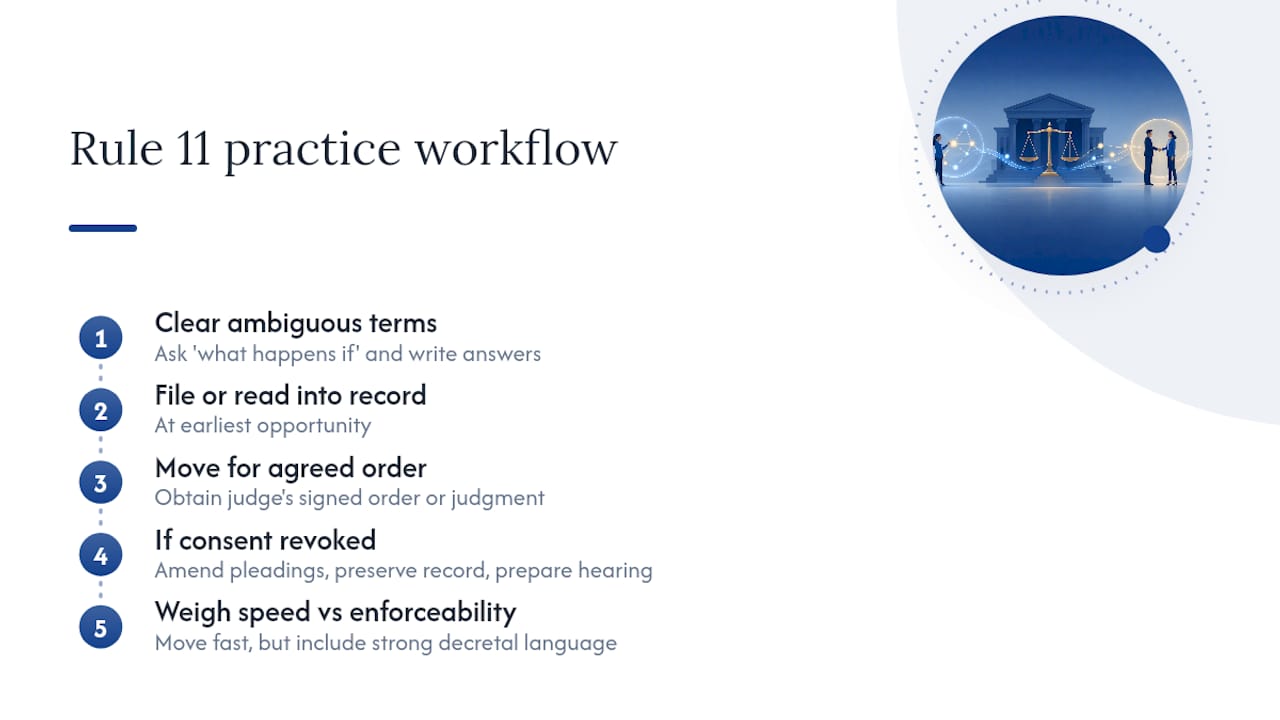
A skilled attorney starts by clearing ambiguous terms before anything is signed. Vague language that both parties think they understand often means two different things, and that gap surfaces at the worst possible moment: when one party tries to enforce the agreement. The attorney’s job at the drafting stage is to ask “what happens if” for every obligation and make sure the answer is written into the document.
Once the terms are clear, the attorney files the agreement or reads it into the record at the earliest opportunity, then immediately moves for an agreed order or agreed judgment. That sequence matters because a party retains the right to revoke consent until the court renders judgment. Speed is a genuine strategic advantage.
“The most common mistake in Rule 11 practice is treating the filed agreement as the finish line. It is the starting line. The finish line is the judge’s signature on an agreed order that incorporates every term.” — Practitioner insight on Texas Rule 11 enforcement
When consent is revoked, the attorney pivots quickly: amend the pleadings to add a breach-of-contract claim, preserve the record, and prepare for the possibility that enforcement will require a full evidentiary hearing rather than a simple motion. The Lexology analysis of Rule 11 enforcement confirms that including decretal language and obtaining the judge’s signature is the most reliable way to preserve continuing jurisdiction and prevent a revocation dispute from unraveling the entire settlement.
The balance between settlement speed and post-judgment enforcement tools is the central tension in Rule 11 practice. Moving fast to lock in an agreement is valuable. Moving fast without the right language is a liability.
Key Takeaways
A Rule 11 agreement in Texas is only as strong as its form: file it, get it on the record, and obtain the judge’s signature on an agreed order to convert it from a private contract into an enforceable court directive.
| Point | Details |
|---|---|
| Meet the formal requirements | The agreement must be in writing, signed, and filed, or made in open court and entered of record under Tex. R. Civ. P. 11. |
| Get judicial incorporation | For custody, support, or property terms, ask the judge to sign an agreed order incorporating the agreement to gain contempt enforcement. |
| Use explicit email language | An email qualifies as a written Rule 11 agreement only if it states: “This email constitutes a Rule 11 Agreement under Tex. R. Civ. P. 11.” |
| Act before revocation | A party can revoke consent before judgment; file and seek an agreed order as quickly as possible to close that window. |
| Lawofficeofannadin can help | The Law Office of Anna Din drafts, files, and enforces Rule 11 agreements in family and civil cases across The Woodlands and Houston. |
The weight of getting it right
Most people who reach a Rule 11 agreement feel relieved. The hard negotiation is over, the terms are set, and the case feels resolved. What they often do not realize is that the moment of agreement is also the moment of greatest vulnerability. A party who has second thoughts can revoke consent right up until the judge signs an order, and an agreement without decretal language may leave the court without jurisdiction to enforce it after the case closes.
The clients who avoid those traps are the ones who treated the agreement as the beginning of a process, not the end of one. They pushed for an agreed order the same day. They used specific dates instead of vague timelines. They asked their attorney to include the judge’s signature line before anyone left the courthouse.
Texas family law is full of situations where the difference between a good outcome and a frustrating one comes down to a single sentence in a document. That is not a reason to be paralyzed by the process. It is a reason to get the language right the first time.
How the Law Office of Anna Din helps with Rule 11 agreements
Reaching an agreement is one thing. Making it stick is another. The Law Office of Anna Din works with clients in The Woodlands, Houston, and surrounding communities to draft Rule 11 agreements that meet every formal requirement, negotiate incorporation language that converts private deals into enforceable court orders, and handle enforcement actions when the other side does not follow through.

Whether you need help drafting a custody or support agreement, filing a procedural stipulation, or pursuing enforcement after a breach, the firm offers focused consultations that cover your specific situation, identify any gaps in existing agreements, and map out next steps. At an initial meeting, you can expect a review of your case facts, a plain-language explanation of your options, and a clear picture of what it will take to protect your position.
To schedule a consultation with a Texas divorce and family law attorney, contact the Law Office of Anna Din directly. Bring any existing agreements, emails, or court filings so the attorney can assess your situation accurately from the start.
Useful sources to read next
These primary and secondary sources are reliable starting points for verifying Rule 11 requirements and finding deeper authority:
- Texas Rules of Civil Procedure (March 1, 2026)
- Rule 11 Agreements | Texas Law Help
- How are Rule 11 Agreements Enforced? The Devil is in the Details (Lexology)
- Rule 11 Agreements Research Guide (Tarrant County law library)
- Texas Family Code §153 (child-support provisions) | Texas Statutes
For case-specific application, consult a licensed Texas attorney. Rules change, and the facts of your case determine which provisions apply.
This article provides general legal information, not legal advice. Confirm current rules and their application to your situation with a qualified Texas attorney or the relevant primary source.
FAQ
What is a Rule 11 agreement in Texas?
A Rule 11 agreement is a written or on-the-record contract between parties or their attorneys in a pending Texas lawsuit, enforceable under Tex. R. Civ. P. 11 when it is signed and filed with the court or made in open court and entered of record.
What happens if you break a Rule 11 agreement in Texas?
If the agreement was incorporated into a court order, the breaching party faces contempt proceedings, attorney’s fees, and enforcement motions. If it remained a private contract, the non-breaching party must typically file a breach-of-contract claim and prove damages.
What is Rule 11 in Texas family court?
In family court, Rule 11 allows parties to memorialize temporary custody arrangements, support terms, and property agreements in writing during a pending divorce or custody case. Those terms become fully enforceable only when a judge incorporates them into a signed order or decree.
Can a party revoke a Rule 11 agreement before the judge signs an order?
Yes. A party generally retains the right to revoke consent to a Rule 11 agreement up until the court renders judgment. Once the judge signs an agreed order incorporating the terms, revocation is no longer available and enforcement proceeds as a court order.
Do I need a lawyer to draft a Rule 11 agreement in Texas?
You are not required to have a lawyer, but legal help is strongly recommended when the agreement covers custody, child support, property division, or any term that requires judicial incorporation to be fully enforceable. The Law Office of Anna Din handles Rule 11 drafting and enforcement for clients across The Woodlands and Houston.