
To change your name as an adult in Texas, file a verified Petition to Change the Name of an Adult in the district clerk’s office of the county where you live and include two fingerprint cards acceptable to DPS and FBI. That single filing, governed by Texas Family Code Chapter 45, sets the entire process in motion.
Before you go to the courthouse, gather your government-issued ID, Social Security number, driver’s license information, and two completed fingerprint cards. One card attaches to your petition; the other goes to the Texas Department of Public Safety along with a court-stamped copy of your petition after the judge signs the order. If the filing fee is a hardship, prepare a Statement of Inability to Afford Payment of Court Costs at the same time. Having all of this ready before you walk in saves you at least one extra trip.
Key Takeaways
Filing an adult name change in Texas requires a verified petition under Texas Family Code Chapter 45, two DPS-compliant fingerprint cards, the correct county filing fee or a fee-waiver form, and prompt action on certified copies once the order is signed.
| Point | Details |
|---|---|
| Where to file | File your verified petition with the district clerk in the county where you currently reside. |
| Required forms | Prepare the Petition to Change the Name of an Adult, a Proposed Order, and a fee-waiver form if needed. |
| Fingerprint cards | Submit two DPS/FBI-compliant hard cards; one with the petition, one mailed to DPS with the stamped petition copy. |
| Filing fee | Many Texas counties charge around $350; confirm your county’s exact fee before filing. |
| After the order | Buy six to eight certified copies immediately and update SSA first, then DPS, passport, banks, and employer. |
| Attorney assistance | Lawofficeofannadin handles petition preparation, filing, and court representation for adults in The Woodlands and Houston. |
Table of Contents
- Who can file an adult name change in Texas?
- How to file your Texas name change petition: a step-by-step checklist
- What fingerprint cards does Texas require for a name change?
- What does filing a Texas name change cost, and how long does it take?
- What happens after the judge signs your order?
- Why county procedures vary and how to find your county’s forms
- When should you hire a Texas family law attorney?
- What most people underestimate about the Texas name change process
- How the Law Office of Anna Din can help with your name change
- Sources
- FAQ
Who can file an adult name change in Texas?
Under Texas Family Code § 45.102, you must be 18 or older and file in the district court of the county where you currently reside. There is no minimum residency period specified in the statute, but you must genuinely live in that county at the time of filing.
The petition itself requires a detailed set of personal disclosures. You will need to provide:
- Your present legal name and the exact new name you are requesting
- Date of birth, sex, and race
- Social Security number
- Driver’s license number and a history of all driver’s licenses issued to you over the past 10 years
- A complete list of all names you have used in the past
- A disclosure of any felony or misdemeanor criminal history, including pending charges
- A statement of whether you are currently required to register as a sex offender
The judge’s standard under Chapter 45 is straightforward: the court grants the name change if it finds the change is in your interest and in the public’s interest. Criminal-history disclosures weigh heavily in that determination. A judge can deny a petition if the change appears intended to evade legal obligations or defraud creditors.
Pro Tip: List every name you have ever used, including maiden names, nicknames used on legal documents, and any name from a prior marriage. Omitting a prior name or understating criminal history are the two most common reasons petitions are denied or later challenged.
How to file your Texas name change petition: a step-by-step checklist
The Texas State Law Library’s adult name change guide outlines the core filing sequence. Follow these steps in order.
Step 1: Prepare your documents
Before you fill out a single form, collect everything you will need:
- Government-issued photo ID (driver’s license or passport)
- Social Security card or number
- Complete driver’s license history for the past 10 years
- All addresses where you have lived in the past five years
- Every name you have used, with approximate dates
Choose the exact new name you want. Write it precisely as you want it to appear on every future document, because the court order will use that exact spelling.
Step 2: Complete the required forms
Three forms make up the standard filing packet:
- Petition to Change the Name of an Adult — the verified petition containing all required disclosures under § 45.102
- Proposed Order Changing the Name of an Adult — the draft order you prepare for the judge to sign
- Statement of Inability to Afford Payment of Court Costs — only if you are requesting a fee waiver
You also attach one completed fingerprint card directly to the petition. Many counties provide their own versions of these forms; always check your county district clerk’s website before using a generic template.
Step 3: File with the district clerk
You have three filing options depending on your county:
- In person at the district clerk’s office in your county courthouse
- Electronic filing through Efiletx, which most Texas district courts now accept
- Email submission where the county permits it (Travis County, for example, accepts emailed petitions to a designated court submission inbox)
Bring or attach: the completed verified petition, one fingerprint card, the filing fee or fee-waiver form, the proposed order, and a copy of your government ID. Ask the clerk for a file-stamped copy of your petition at the time of filing. You will need that stamped copy later for the DPS submission.
Step 4: Wait for the judge’s review
Most uncontested petitions do not require a hearing. The judge reviews the petition and, if satisfied, signs the proposed order. If the court schedules a hearing, you will receive notice and must appear.
Step 5: Obtain certified copies immediately
Once the order is signed, request certified copies from the district clerk before you leave the courthouse. You will use these copies to update every government record and financial account.
| Agency to update | Documents needed | Notes |
|---|---|---|
| Social Security Administration | Certified order + photo ID + proof of citizenship | Update SSA first — other agencies often require an updated SSA card |
| Texas DPS (driver’s license/ID) | Certified order + current DL/ID + applicable fee | Visit a DPS driver’s license office in person |
| U.S. passport | Certified order + current passport + passport renewal form | Follow State Department procedures based on passport age |
| Banks and creditors | Certified order + updated government ID | Each institution sets its own process |
| Employer/payroll | Certified order + updated SSA card | Required for W-2 accuracy |
| Voter registration | Certified order or updated DL | Submit to your county voter registrar |
What fingerprint cards does Texas require for a name change?
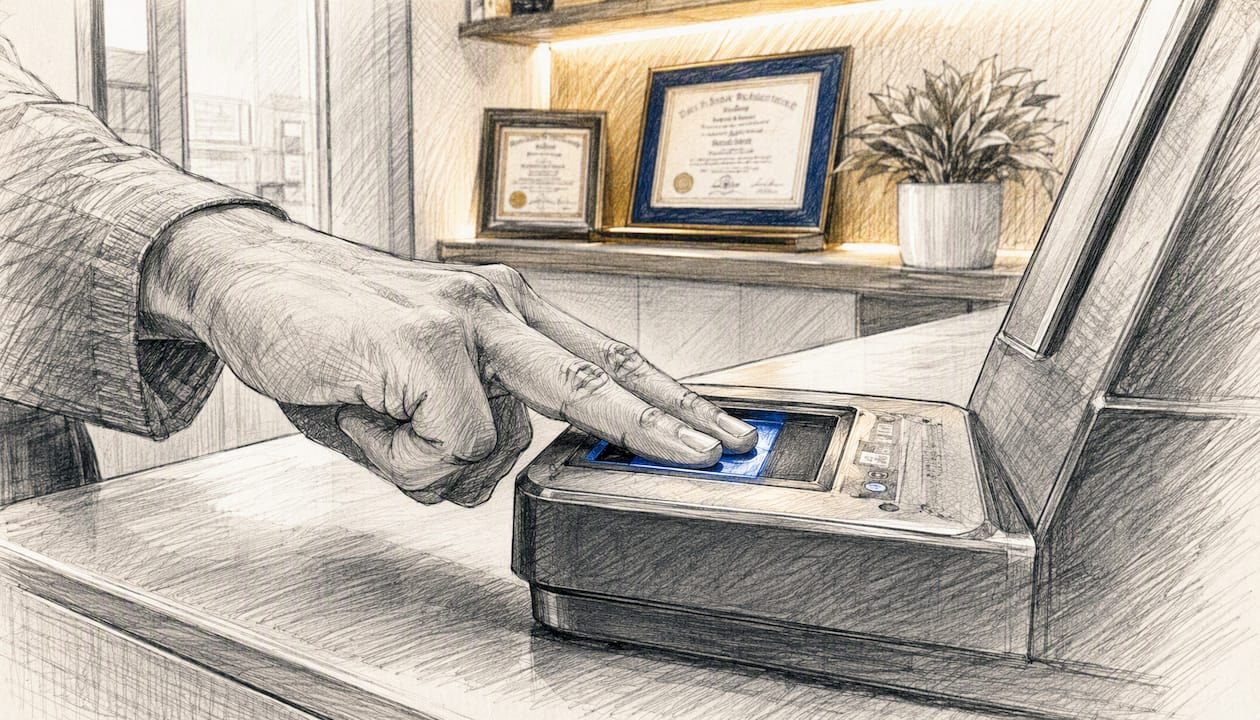
The DPS CR-65 fingerprint instructions specify exactly what a fingerprint card must contain for a legal name-change petition. DPS and the FBI will reject cards that are missing fields or contain illegible prints.
Your fingerprint card must include:
- Full printed legal name (your current name, not the requested new name)
- Signature in your current legal name
- Date fingerprints were taken
- Place of birth (city and state or country)
- Driver’s license number entered in the MNU field
- Reason fingerprinted: write “Legal Name Change”
- Date of birth, sex, race, and height/weight
You need two cards total. One attaches to the petition you file with the district clerk. The second card goes to DPS by mail, along with a court-stamped copy of your petition after the judge signs the order.
Where to get fingerprinted: Identogo is a widely used vendor for physical fingerprint cards in Texas. When you schedule your appointment, specifically request the service that produces physical hard cards, not just an electronic scan. Verify with the vendor that they will complete the MNU field and the reason field correctly before you leave. Private fingerprinting vendors and some county passport offices also provide this service.
Pro Tip: Sign both fingerprint cards using your current legal name, not the name you are requesting. Keep a clear photocopy of both completed cards before you submit them. If DPS rejects a card, having a copy helps you identify the error quickly.
What does filing a Texas name change cost, and how long does it take?
Filing fees
Texas counties set their own filing fees. Dallas County’s published fee schedule lists a name-change filing fee of $350, and Midland County’s fee schedule lists the same amount for an adult name change. Many counties cluster near that figure, but your county may differ. Always confirm the current fee with your district clerk before filing.
If you cannot afford the filing fee, submit a Statement of Inability to Afford Payment of Court Costs with your petition. A judge may approve the waiver, but may also request documentation of your income and monthly expenses. Prepare bank statements or pay stubs in case the court asks.
Timeline
There is no fixed statutory waiting period. Most uncontested petitions move through the process in several weeks to a few months, depending on:
- Your county’s current court docket
- How quickly DPS completes the background check
- Whether the judge requires a hearing
- Whether your fingerprint cards pass DPS review on the first submission
Common causes of delay
- Fingerprint card rejected by DPS due to missing fields or illegible prints
- Forgetting to include the court-stamped petition copy with the DPS mailing
- Incomplete petition (missing prior names, criminal-history omissions)
- Filing fee unpaid or paid to the wrong account
- Contested petition requiring a hearing
- Locked PDF or DocuSign order that the judge cannot sign electronically (see county variations section below)
What happens after the judge signs your order?
A court-ordered name change does not automatically update any government or private record. You must present certified copies of the signed order to each agency yourself, as the Texas State Law Library confirms.
Purchase at least six to eight certified copies from the district clerk. Some agencies keep the copy permanently; others return it. Having extras prevents delays when multiple agencies need to process your request simultaneously.
Start with the Social Security Administration. The SSA’s name-change process requires your certified court order, proof of identity, and proof of U.S. citizenship or immigration status. Once SSA updates your record and issues a new card, use that updated card as supporting documentation when you visit Texas DPS for a new driver’s license or state ID.
After DPS, update your U.S. passport through the State Department, then move to banks, your employer’s payroll department, and voter registration. Each agency charges its own fees for reissued documents.
Pro Tip: Purchase at least six to eight certified copies the same day the order is signed. Ordering additional copies later often costs more and takes longer. Store digital scans of the signed order in a secure, password-protected location as a backup.

Why county procedures vary and how to find your county’s forms
Texas has 254 counties, and each district clerk’s office sets its own procedures within the framework of state law. What works in Travis County may not work in Harris County or Bexar County.
Common differences between counties include:
- Filing fee amounts — confirm before you arrive
- eFile availability — not every county accepts Tyler eFile for name-change petitions
- Email submission for judge signing — some counties allow you to email the proposed order to a court inbox after filing; others require in-person pickup
- County-specific form versions — some clerks require their own petition template rather than a generic state form
- Fingerprint handling instructions — a few counties provide specific guidance on how to attach the card to the petition
Travis County as a practical example
Travis County publishes a detailed adult name-change packet through its law library. The Travis County instructions (revised August 2025) cover the complete local workflow: which forms to use, how to file in person or via eFile, the email addresses for submitting the proposed order to the judge for signing, and how to obtain certified copies. The packet also includes a fee-waiver form example and notes the $350 filing fee.
Use Travis County’s packet as a model for what a well-organized county process looks like, then find the equivalent page for your own county.
How to find your county’s instructions
- Search “[your county name] district clerk name change Texas”
- Look for a “forms” or “civil filing” section on the district clerk’s official website
- Call the clerk’s office directly to confirm the current fee, accepted filing methods, and any local requirements
Warning about locked PDFs: Some counties distribute proposed-order templates as locked PDFs or DocuSign files that a judge cannot sign electronically. If your county’s form is locked, print it, then scan or save it as a new PDF before submitting. A locked file that reaches the judge’s desk without this fix is one of the most avoidable delays in the entire process.
When should you hire a Texas family law attorney?
Self-representation works well for straightforward, uncontested petitions with no criminal history and no complications. For many situations, though, working with a Texas name change attorney is the more reliable path.
Consider hiring an attorney if any of the following apply:
- You have a felony conviction, pending charges, or a sex-offender registration requirement
- Another person contests your petition
- You are a participant in an address-confidentiality program or have a protective order in place
- The name change intersects with immigration status or a pending immigration application
- You have used multiple names across different legal documents and need to reconcile them
- You want the forms prepared and filed correctly the first time, without the risk of a rejection or delay
A family law attorney handles form accuracy, verifies county-specific requirements, communicates with the district clerk and DPS on your behalf, and represents you at a hearing if one is scheduled. For contested petitions, having counsel is not just convenient; it can determine the outcome.
If your name change follows a divorce, the process may be handled as part of the divorce decree itself, which is a separate and often simpler route. An attorney familiar with both processes can advise which path fits your situation. You can also review how local court procedures work in related matters by reading about filing for divorce in The Woodlands.
What most people underestimate about the Texas name change process
The paperwork itself is manageable. What catches people off guard is the fingerprint submission, and it derails more petitions than any other single step.
Most applicants assume that getting fingerprinted is the easy part. It is, until DPS rejects the card because the MNU field is blank, the reason field says “background check” instead of “Legal Name Change,” or the petitioner forgot to mail the court-stamped petition copy alongside the card. Each of those errors adds weeks to the timeline while you wait for DPS to process a corrected submission.
The second underestimated issue is county variation. Readers who follow a generic online guide and then file in a county that requires its own form version, or that does not accept eFile for name changes, discover the mismatch only after the clerk rejects their documents. Calling the district clerk before you file takes five minutes and prevents that outcome entirely.
One more thing worth saying plainly: the fee-waiver process is not automatic. Judges have discretion to ask for income documentation, and a waiver request without supporting paperwork can stall your case. Prepare your financial documents before you file, not after the court asks for them.
How the Law Office of Anna Din can help with your name change
Preparing a name-change petition correctly the first time saves weeks of back-and-forth with the district clerk and DPS. The Law Office of Anna Din handles the full process for adults in The Woodlands, Houston, and surrounding Texas communities: document preparation, petition filing, fingerprint guidance, and court representation if a hearing is required.

For name changes connected to a divorce or other family law matter, the firm can address both in a single engagement, so you are not managing two separate legal processes at once. Anna Din’s team knows the local court procedures and clerk requirements across the Houston area, which means fewer surprises and faster results for you.
To learn more about how the firm assists with adult and child name-change petitions, visit the name change practice page. If you are ready to schedule a consultation, contact the Houston office directly. You can also review the firm’s success stories to see how Anna Din has helped clients through complex family law matters.
Sources
The following official sources govern the Texas adult name-change process and should be your first stop for verifying current requirements:
- Texas Family Code Chapter 45 (official statutes)
- Adults – Name Changes in Texas – Guides at Texas State Law Library
- TCLL – FM-NCA-Info-001 Adult Name Change in Travis County, Texas (Rev. 08/27/2025)
- CR-65 fingerprint instructions (DPS)
- CIVIL/FAMILY FILING FEES COST DETAIL (Dallas County)
- Fees | Midland County, TX
- Texas Family Code – FAM § 45.102 | FindLaw
- Social Security Administration name change guidance (FAQ)
This article is general information, not a substitute for advice from a qualified lawyer. Consult a qualified legal professional about your own circumstances before acting on anything here.
FAQ
How do you legally change your name as an adult in Texas?
File a verified Petition to Change the Name of an Adult with the district clerk in your county of residence, attach a completed fingerprint card, pay the filing fee (or submit a fee-waiver form), and wait for the judge to sign the proposed order under Texas Family Code Chapter 45.
How much does an adult name change cost in Texas?
Filing fees vary by county. Dallas County and Midland County both list the fee at $350, but your county may charge a different amount. Confirm the current fee with your district clerk before filing, and ask about the fee-waiver process if cost is a concern.
How long does a legal name change take in Texas?
There is no fixed statutory waiting period. Most uncontested petitions are resolved within several weeks to a few months, depending on your county’s court docket, DPS background-check processing time, and whether the judge requires a hearing.
Do I need an attorney to change my name in Texas?
You can file on your own for a straightforward, uncontested petition with no criminal history. An attorney is advisable if you have a complex criminal record, a contested petition, an address-confidentiality situation, or if the name change intersects with immigration status. The Law Office of Anna Din assists adults with the full name-change process, including contested cases.